Showing posts with label food. Show all posts

21 March 2010

Russian Night, or Who knew caraway had such a noble purpose?

We recently got together with some friends for "Russian night."

What you see here in the photo is caraway-infused vodka (served in actual Russian glasses one of our friends had picked up on her travels).

Really, it was better than straight vodka ought to be. You drink it chilled, and the smell and taste is amazing. It isn't until after you swallow that you realize you are drinking undiluted vodka.

The menu...
H'ors d'ouevre
Smoked salmon (Alaskan, but we figured since you can see Russia from Alaska, that was close enough)
Chopped egg paté (Iaichnyi Pashtet)
Russian potato salad (a la Mendoza)
Beverage: Caraway-infused (tminnaia) vodka


First course
Borscht
Beverage: Old Rasputin stout beer

Main course
Chicken Satsivi (Tsyplionok Satsivi)
Hungarian wine (it's as close to Russian as we could get here)

Dessert
Blini, with various toppings including honey and preserves
Tea

I had actually tried to Google for info on Russian cuisine, but I didn't love the resources I was finding. So to the trusty library went I, and I found The Art of Russian Cuisine, by Anne Volokh with Mavis Manus. (I also found another book, Joyce Toomre's adaptation and translation of the Russian cookbook A Gift to Young Housewives, by Elena Molokhovets, who was sort of the 19th-century Russian Escoffier. Amazing, but not useful for our purposes.)

B and I made the egg paté, the chicken Satsivi, and the caraway-infused vodka. I would definitely make any of these again. The egg paté turned out to basically be a pretty typical egg salad, chopped really finely, with an emphasis on dill. I did follow the recipe explicitly in the arrangement: a mound of egg in the center with slices of cucumber, oil-cured olives, and sprigs of parsley alternating around the mound. The chicken Satsivi was awesome -- both texture and flavor. The Satsivi sauce is, as the Volokh book describes it, "a cold walnut sauce whose exquisite bouquet enhances poultry, fish, or vegetables." We settled on it partly just because it is recommended to serve it room temperature -- an ideal quality if you are carrying it to someone else's home for dinner.

Tminnaia Vodka (Caraway Seed Vodka), from The Art 0f Russian Cuisine

2 tablespoons caraway seeds
1 quart vodka

Mix the caraway seeds and vodka, seal, and leave for one week or more at room temperature. Strain through several layers of cheesecloth [we used a coffee filter], reseal, and refrigerate before serving.

Everyone's contributions were delish and we had a great time. I'm only sorry I ended up being too tired to stay and have a postprandial glass of tminnaia vodka!

As always with this kind of themed meal, I ended up learning heaps about a culture and cuisine I previously had known very little about.

And let's hear it for libraries!
(See, the internet is simply no substitute for books.)


19 December 2009

A better muffin paper


Again, I find myself posting about food because I had a conversation with one person (in this case, my mom) about something and figured hey, if I'm taking pictures and writing something up, might as well post it here.

I've had a total breakthrough with muffins. Well, I'm sure others have figured this out before me, but it was a breakthrough for me. I've never liked using muffin papers -- they aren't attractive and they rip off a layer of the muffin when you peel it off. And even if you grease your tin instead of using papers, you can get some attrition there too. Besides, again, the too-smooth look of the muffins from the tin isn't that aesthetically pleasing to me. You know, it's like the bread that is baked in a loaf pan, versus bread that is baked free form. The loaf has that loaf-pan look and the crust that was inside the pan is never as good as the crust on the top.

So this morning I decided to make muffins. We had many bananas all ready to go, so I made these. Quite a good recipe, if you like banana stuff (sorry Mom). Anyway, I decided to try using just plain parchment paper as muffin cups. (I had no store-bought papers, but I'd also been meaning to try it.)

I figured out how big I needed them to be to line a cup (about 4 inches square) and cut out 12. Of course they paper squares aren't that willing to get into the cups, so to fille them, I had to sort of form them to cup shape, hold it with one hand, and drop a little batter in (enough to hold it down, I added the rest after I'd gotten all the papers anchored). After a couple of them, I pretty much had the hang of it.

The results were fabulous. They were interesting looking -- so much better than those crinkly muffin cups -- and looked great all nestled together in their papers. But unwrapping them was the real surprise. Not only did they not stick at all (not a single crumb lost!), but because there is space between the batter and the side of the pan, the entire muffin comes out browned. You get this interestingly shaped, perfectly textured little muffin nugget.

It is hard not to get some batter on the papers, but I think a careful cook could do better than I did. And I might do better next time. I was happy to discover, however, that if you wanted to serve these in the papers but make it look less like a five-year-old filled the muffin cups, those little crunchies come off the paper really easily. It's takes some of the pressure off to know that you can tidy them up somewhat without much effort.

I will never go back to the store-bought muffin straightjackets. Sure, this is a little more trouble than muffin papers, sure, but payoff in the appearance and the overall quality of the muffin were totally worth it.


The muffin, unwrapped.


Paper from the side.

19 July 2009

Rhubarb, research, and the recipe box


I initially just set out to transcribe and email the rhubarb mousse recipe (below) for friend Miriam (who occasionally tweets about rhubarb this or that). I remember loving this and can't believe I actually came across the recipe in my files. But as my preamble to the recipe got longer and longer, I figured I'd just roll with it and put this all up as a blog post.

I don't have the info on the actual source of this recipe. It's a magazine clipping that I found about 20 years ago in the "rhubarb" section of Mom's recipe box. (Mom: There may not really be a "rhubarb" section, but I like to think there was. I know there is a "zucchini" section. Sadly, the strawberries never were so prolific that a "strawberry" section was required. And anyway, you hardly need a recipe to make the most of homegrown strawberries: wash, trim/slice, put in bowl, eat.) I think I was in college, but just barely as we still lived on Oriole Lane when I made it. How can I be so sure what kitchen I was in, you wonder? Well, I distinctly remember the stove I was cooking on because I turned my back on the gelatin-sugar mixture and ended up with some extraordinary cleanup. So I do recommend attentiveness to that step.)

Recipe is true to orig.--I've even left in the food coloring ingredient in the instructions though I'm sure I wouldn't bother. I was a bit surprised by the style of directions when I typed this up. I mean, do magazines use semi-colons in recipes nowadays?

And like most of the cards from a certain era that are in Mom's recipe box, this clipping is pasted onto a used index card from Dad's research: "Ovulation, GnRH on, in teleosts, 46-47." And yes, I looked it up: GnRH is gonadotropin-releasing hormone and teleosts are bony fishes.

So anyway, the recipe:

RHUBARB MOUSSE
Light, airy, and oh-so-scrumptious--

1/2 cup sugar
1 envelope unflavored gelatin
3/4 cup water
1/2 teaspoon finely shredded orange peel
2 cup rhubarb cut into 1/2-in pieces
Several drops red food coloring (optional)
3/4 cup whipping cream, whipped
Orange peel strips (optional)

In a small saucepan combine sugar and gelatin. Stir in water and finely shredded orange peel. Cook and stir over low heat till gelatin is completely dissolved. Bring to boiling; add rhubarb. Reduce heat; cover and simmer about 5 minutes or till rhubarb is tender. Cool slightly.

Pour mixture into a blender container or food processor bowl. Add red food coloring, if desired. Cover; blend or process till smooth. Pour into a bowl. Chill to the consistency of unbeaten egg whites (partially set). Fold in whipped cream. Spoon into 6 dessert dishes. Cover; chill 6 hours or till firm. If desired, top with orange peel strips. Makes 6 servings.

Nutrition information per serving: 179 cal., 2 g pro., 19 g carbo., 11 g fat, 41 mg chol., 14 mg sodium.


*No, that isn't an actual photo of my mom's recipe box, but it almost could be. Those "old-fashioned stove" design recipe cards must have been very popular! Photo is from http://www.flickr.com/photos/petitshoo/ / CC BY-NC 2.0

31 August 2008

Bonsai and andagi

This past weekend B and I went to the Okinawan Festival at Kapiolani Park. We'd gone last year and watched some of the performances and shared some Okinawan soba. In the blazing heat of a late August midday. We couldn't believe how many people were there -- and truly of all ages.

This year, we poked around more and did a little shopping and checked out some of the cultural/historical stuff. I can see why they say that Okinawa is much like Hawaii -- very much a product of many influences (including Portuguese).

Half of the culture tent was dedicated to a bonsai show by the Hawaii Bonsai Association. Outside, there was a demo -- it was really fascinating. (Incidentally, the fellow doing the demo and answering questions is one of the regulars B sees when he goes boogie boarding in the morning.) It was interesting to see the special tools and wires they use (they mostly have to come from Japan, but we got a tip that you can now get cheaper wire from Vietnam). I was surprised at how very un-delicate some of the work was. Our demonstrator was really twisting and torquing his little tree, binding it with heavy, malleable wire that requires some real wrestling. (Hence the helper holding the pot.) His plan is to make the tree look like it grows where there is snow in the winter, so he is training the branches to all turn down. He has been working on this tree -- the one on the photo's right -- since 2002.

We would have stayed with the bonsai demo longer, but all that learning was making us hungry. It was, again, a blazing hot day (it's starting to look like this is typical for this time of year), but we managed to rise to the occasion and eat andagi (in the photo), which is basically the Okinawan doughnut. It's hard to go wrong with fried dough and andagi is no exception! Then we picked up some plates of food (and took it to join some friends in Manoa for a potluck lunch). We got champuru, which I'd never had (although I'd heard the word because a local Twitterer's handle is @champuru.)

Honolulu Advertiser photos from the festival here.

More of our (very amateurish) bonsai photos after the jump. These aren't great quality photos -- I think B got one just as good using his phone! -- but they do show a variety of plantings.


All of these plants are done by members of the Hawaii Bonsai Association.


14 August 2008

Visiting the Garden Island

We were recently "off island," as they say. We spent a lovely week on Kauai with Tips & Burp. We ate at a couple of great restaurants -- Lighthouse Bistro and Bar Acuda (I didn't get that until I said it out loud...and saw the fish on their sign...). And we went on a lovely boat ride around the Na Pali Coast (viewing many famous movie backdrops including the entrance to Jurassic Park) on Holo Holo Charters on their teeny, tiny sailing catamaran.

This may be my favorite picture of the trip. (Ok, my second favorite. See below the jump.) This is at the taro fields overlook near Princeville, Kauai.
We're looking forward to seeing T and B's photos as well. (Hey guys, I am so going to burn ours and mail them. Really, really soon.)


And this is my favorite photo from our trip.
Doesn't B look...I don't know...salty?


07 July 2008

SFO eatin' & drinkin'

Had a great time in SFO on my trip a couple of months ago (it took me a while to finish up this post, obviously). Learned a lot of relevant professional stuff at the conference I was attending (the International Studies Association annual meeting), but also had a lovely time eating and drinking with friends (some old, some new) at all kinds of establishments.

Alembic Bar - Went with a bunch of folks to this funky bar on Haight St. The food we had was fabulous -- I had bavette steak with chimichurri sauce (photo left). I had a couple of Belgian beers. Mmm. 1725 Haight St.

Cafe Prague - I had Hungarian Szeged Goulash with dumplings (great), the beers were great, and we thought our Czech waiter was adorable. Not a great vegetarian selection so my friend got fried cheese. Yelpers give it mixed reviews, but I'd probably go again. (We had intended to go back for the accordion party on Friday, but ended up doing something else.) 584 Pacific Ave.

Colibrí - a lovely Mexican restaurant. I had green mole and duck. And the guacamole we had with our margarita course was amazing. 438 Geary St.

Cafe Mason - Chosen for its proximity to my hotel because I needed to check out right after breakfast. As I picked it over other more popular options, I was relieved that it ended up being a pretty great little breakfast spot. I got some sort of crepe and fruit thing and it was fabulous. Coffee was good too. I think all of the waitresses were from the same Eastern European or former Soviet country. It was great.

Cafe Trieste (North Beach) - Very cool coffee shop with very good coffee and excellent pastries. 609 Vellejo Ave.

Hana Zen - We were very hungry and cold and the udon noodle soup with vegetable tempura hit the spot. So did the sake.

Hidden Vine - A real hole in the wall kind of place, but great. My friend and I learned not to assume we won't like a wine if it's from California (although I'll still say it'd be an exception if I really like it). If I'm remembering correctly, our eye-opening red wine was from Bighorn Cellars, but I no longer remember the varietal...

John's Grill - a meat-and-potatoes kind of place, touristy, but it seemed like it would be fun to go. It is a setting in The Maltese Falcon and is -- or, rather, was -- the home of one of signed publicity copies of the movie's falcon statue.

King of Thai - looking for a quick-ish lunch on a break and stumbled into this place. It was packed when we arrived, so we'd ordered 'to go,' but by the time our food was ready, there were plenty of seats so we ate in. (Which was good, as we really didn't have any place to go to eat our take-away!) We were quite happy with our meals and it was very reasonable. And I loved the green plates.

09 June 2008

Food and the people who write about it

The 2008 James Beard Foundation award winners were announced this past weekend, and as always, JBF has the results updated on the website super fast. (A side note: They've done a complete redesign of their site since I had last visited. My recollection is that the navigation has improved, but even more striking is that the appearance has dramatically changed. A bold look without too much Flash.)

Greg Patent's latest book, A Baker's Odyssey (which I wrote about here), was a finalist in the 'Baking and Dessert' category, although the winner in that category went to Peter Reinhart's Whole Grain Breads: New Techniques, Extraordinary Flavor (which I know nothing about, but it sounds like good idea).

Heidi Swanson, the author of one of the food blogs I follow, '101 Cookbooks', was a finalist in the 'Healthy Focus' category for her cookbook Super Natural Cooking: Five Ways To Incorporate Whole and Natural Ingredients into Your Cooking. It's not just the site's recipes that entice -- her food photos are gorgeous.

No Hawaiians were nominated for Best Chef in the Pacific region (all finalists were in California), but the Best Chef for the Southwest region (I'd be interested in hearing how they decided on their regions) is Lachlan Mackinnon-Patterson at Frasca Food and Wine in Boulder. This note-worthy chef is not in Aspen, or even Denver, but in little ol' Boulder. I love it. I haven't dined there, myself, but we've heard good things about it. Maybe I'll get there on one of my future visits. (Question to The Folks: Have you eaten there?)

And the ever-reliable Epicurious.com -- a site I couldn't cook without -- won for 'Website Focusing on Food, Beverage, Restaurant, or Nutrition.' (Nice concise description for that category, eh?)

And a personal recommendation:
Another of my own favorite recipe blogs is 'Simply Recipes.' I diligently forward any ice cream recipes to Sister (who has a machine) and have promised to send all of this summer's zucchini recipes to The Folks in anticipation of their annual squashy bounty. (Sister reports that the Strawberry Frozen Yogurt -- made with fresh berries from their local farmers' market -- was a big success at a recent gathering.)

P.S. Upon further exploration, I see that the JBF site is still under construction, so not all functions are up yet. A work in progress.

P.P.S. Sorry about the double post (those of you who get this via feed). Stupid Ctrl key so close to the Shift key....!

11 February 2008

A cultural exchange

We got a kick out of some recent special packaging for some locally made corn tortillas (much better than the other brand available at the grocery store, by the way). We were surprised to see a local brand named after a Mexican state, Sinaloa, but we were even more surprised to see these corn-headed characters depicted on surfboards...

The back of the package tells us:
The mythical Mayan twins, Hunahpu and Xbalanque, surf the waves of Hawaii in a cultural exchange. They are symbolized by their corn heads [...]. Hunahpu and Xbalanque, according to Mayan legend, were responsible for tricking the ant into bringing corn seed from the underworld to this world, thus bringing stability and civilization to the indigenous peoples of the Americas.

Amazingly, our tortilla choice is in perfect sync with B's course content this semester.

09 February 2008

New Patent book

Family friend, cookbook author, and NPR favorite Greg Patent has a new food history/recipe book coming out, A Baker's Odyssey. I just caught this piece on the NPR: Books podcast. The article online has some recipes, but the audio piece is a discussion with Greg about his own background and the work for the book as he makes the Cheese Sambouseks in his home kitchen.

Greg has an interesting bio -- among other things, he lived his first 10 years in China, his pre-culinary career was as a zoology professor, and he used to tour as a spokesman for Cuisinart. His wife Dorothy Hinshaw Patent is also a writer. She mostly writes non-fiction books for children, and one of her books was a finalist in the 2003 Spur Awards (Western Writers of America) when I was doing work for them (and serving as a judge in another category). She politely sent her regrets about attending the WWA convention, as they would instead be attending the awards banquet for the James Beard Foundation the same week. Greg was nominated for and received the prestigious award for the best baking book of 2003 with Baking in America.

Our favorite pancake recipe is, incidentally, from Greg's 1996 book, New Cooking from the Old West.

21 January 2008

They lay eggs?

The other night, I was looking through recipes for an appetizer to bring to a dinner party. I passed a potential selection over to B to see what he thought.

I was thinking it was pretty reasonable, so was surprised when he suddenly laughed.

As a result of one of those funny eye-brain mis-coordinations, he'd read "1 egg yolk" as "1 yak egg."

Those would probably be really big, huh?

Photo: Oliver Whiteside

19 January 2008

Queso relleno

I have been in Yucatán several times, but I recently had queso relleno and learned that it is a favorite of Yucatecans and considered very much to be a traditional specialty.

This is one of those meals that has a long lead-in, and the anticipation that builds on the way to the final product makes it even better.

It starts as a ball of Edam cheese (Dutch) to which you perform 'open brain surgery.' You then scoop small amounts every day or so and eat it with whatever (bread, tortillas, crackers, a spoon. The last was LK's favorite).

Over time, you end up with a hollow and a very sturdy, thick cheese ball. The next few steps are up for debate, but the essential idea is that you stuff the hollow cheese ball with ground beef, capers, raisins, and a few spices (sorry, ancient Mayan secret). You stick the whole thing in the oven, then cut open and serve.

My Yucatecan relative fondly remembers his mother scooping the cheese pieces, and his anticipation for the final product that fed the entire family (and then some) a very hearty and delicious meal (served with a white sauce).

We had this at the Restaurante El Príncipe Tutul-Xiu in Maní, Yucatán. This is one of their specialties in addition to Poc Chuc.

(Note: the Edam cheese sample photo is at the Dr.'s house. Eventually this will become a queso relleno. Too bad we had to leave before it was finish. We did try!).

02 August 2007

Thinking of you...

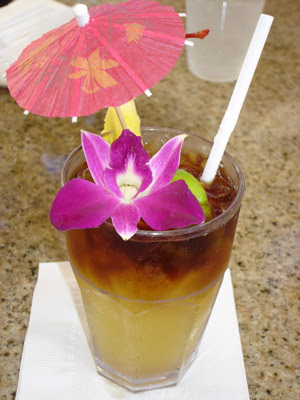
I was reminded yesterday by our friend Doc Mara (North Dakota resident but a beach boy inside) that even a virtual Mai Tai is better than no Mai Tai at all...

Enjoy!

This particular Mai Tai photo is from the patio bar under the famous banyan tree at the Moana Surfrider hotel.

I am not sure what B's top-secret recipe is for these, but it's definitely a relative of the Trader Vic's recipes. You can find a compendium of relevant versions here. B always puts in the umbrellas (otherwise your pineapple would fall in), but maybe we need to consider the orchid too. That's a nice touch.

16 June 2007

Belgian night

We recently had a dinner that was Belgian-themed in honor of the Paris-Roubaix bike race. Since both LK and B contributed to this write-up (and some might even say these are really recipes), I'm posting it here instead of Q-eats. (I should perhaps clarify at this point that the "I" of this posting is LK. B did most of the description of the chips process.)


The most authentically Belgian thing we made was the Felmish stew: your basic beef-and-beer stew. It was great -- and loads better the second day (I always forget that as I so rarely make a beef stew). It had amazing depth of flavor.

But that isn't what we are here to talk about today. The real highlight of the meal for us was opener: the homemade chips and accompanying dips. And while honestly there isn't much Belgian about the chips, it was a riff on the theme. The Belgians are famous for their fries (pommes frites) -- we just did our version as thin chips -- and the sauces were also inspired by the diverse toppings that are put on pommes frites.

THE CHIPS
One should not clean the kitchen prior to taking this on. One should, however, wear clothes, for safety reasons. (Even Jamie Oliver will tell you that actual naked cooking is not safe.) Our other deviation from Belgian tradition here is that we used canola oil rather than animal fat. Peanut oil is also fab for frying, but we usually just use what we have, within reason.

B is the man here. He does all the dirty work.


mixed potato chips


equipment:
large wok, a mandolin or some other tool for even slicing (this is key -- you can't have too much variation in thickness or you'll go crazy trying to cook them), a mesh strainer thing (a quick Google shows me that these are actually called mesh skimmers), and an apron.

ingredients:
russet potatoes
sweet potatoes -- we use Okinawan sweet potatoes which are grown locally. they are a gorgeous purple!
oil for frying
salt

So slice up as many chips as you want--skin and all. Heat the oil and wait. B favors a slow heat up process and then works from there in terms of temperature. He tests if it's hot enough by putting a couple of potatoes and watching how it reacts. (Note: You'll want to have clothes on by this point for sure.) If it just sits there with no bubbles coming off it, it's too cool. If it begins to bubble rather fast and starts browning within a short period of time, it's too hot. It's safest to start a tad cool and then adjust it a bit in the first or second batch. Fry the chips in batches, remove them from the oil and salt them, then let them sit on paper towels. Remember that they will continue cooking a bit more once you take them out of the oil.

This is a very s-l-o-w process. Obviously, if you have a fryer, it'd be faster. We experimented a bit and learned that once these are totally cool, you can bag them up in large ziplocs and they hold up for at least a day (we've always eaten them by the second day, but they might well be good longer). This is essential if you are actually having people over -- you don't want to have just been having a big fry-fest.


THE DIPS
Now, the sauces. As usual, I've only loosely followed recipes. But basically, one is a tomato coulis and one is tarted-up yogurt (my own invention). In fact, finding your own coulis recipe might be better than me telling all the ways I deviated from the recipe I used. But I will give you a description of the yogurt dip.


tarted-up yogurt dip

drain yogurt for a few hours. To do this, you'll want to take about half-again-as-much yogurt as you want to end up with (you lose volume when it drains). I drain my yogurt in a seive lined with a coffee filter suspended over a bowl; make sure there is plenty of room for liquid to collect in the bowl.

zest a lemon
chop some chives

mix the yogurt, lemon, and chives. You may wish to add salt, but remember the chips will be salted as well.


And last but not least, don't forget that all of this is best with Belgian (Trappist style) beer. In goblets, of course.

19 April 2007

Good food, etc, addendum

B was having trouble loading photos (or fotos) yesterday so, on his request, I added some that he'd emailed me that seemed to be appropriate. Well, it turns out there were more coming. It turns out there are some food photos that are better than a partial bowl of chimichuri sauce. (Oh, but I still would have used that soup. That's a boiled quail egg there.) I was just munching on my own much less impressive lunch at my not-very-exotic desk and checked on what else he'd sent. He also sent a picture of what he was talking about how the photos of the famous people on the walls were "classier" than what he'd seen other places. (I get it now.)


18 April 2007

Good food, good service, good prices

So here is a short visual tour of a comida I just had in the DF. This is an Argentinian food restaurant, but I understand that they will prepare just about any meal a customer asks for, even if its not in the menu. I believe it.

This is, after all, a restaurant that has 2 walls full of photographs of very famous people that have eaten there. Some I spotted quickly: Gabriel García Márquez, Carlos Fuentes, Carlos Monsivais... the list goes on. Oh, no silly photos like you might see in other restaurants that like to brag of similar fame. All are classy professional looking people and photos (many are world famous writers).

They will bring a coat rack to your table, take your coat or purse, bring you drinks, take your order and you just eat. Yeah, you just eat. No bothersome "hello-my-name-is-Perfecto-and-I-will-be-your-server-today-is- everything-OK" waiters. When you, the customer, fells that there is something missing, you just lift your eyes and there will be a waiter there actually looking out for you but not bothering you until your tequila, beer glass or plate are empty. Then the item disappears along with the waiter almost imperceptibly only to be replaced with the next course or a fresh drink if you give the proper nod.

And the food? Well it was simply fantastic.

Total cost for a 4 course meal with drinks for 5 people: about 2,000.00 pesos. You do the math.